I’d wanted to visit the Christmas markets in Colmar, France, for years. Every December, photographs of its colorful half-timbered houses, cobblestone streets, and elaborate Christmas decorations seemed to appear everywhere. It looked like a little town straight out of a fairy tale, but I wondered whether it could possibly be as beautiful in real life.
Having now visited Colmar during a solo trip through France’s Alsace region, I can say that it absolutely lived up to my expectations. In fact, it became one of my favorite Christmas market destinations in Europe.
But there was one thing I hadn’t fully anticipated: the crowds. By early evening, some of the streets were so packed that I found it difficult to enjoy the markets, even though I was visiting on a Monday.
So, are the Colmar Christmas markets worth visiting? I think they are, but when you visit and how you plan your day can make a huge difference to the experience.
In this guide, I’m sharing what I genuinely loved about Colmar, what surprised me, how much I spent, and the things I’d do differently if I visited again.
This article may contain affiliate links. If you book through one of these links, I may earn a small commission at no extra cost to you. All opinions are based on my own experience.
Colmar Christmas Markets at a Glance
Location: Colmar, Alsace, northeastern France
2026 dates: November 23 – December 29
Number of markets: Six
Admission: Free
Opening hours: Monday–Thursday, 11 a.m.–7 p.m.; Friday–Sunday, 10 a.m.–8 p.m.
Best time to visit: Weekday mornings and early afternoons
How long to spend: At least 4–6 hours, ideally a full day
My verdict: Absolutely worth visiting, but expect serious crowds after dark.
Hours differ on certain holidays. The Gourmet Market, Ferris wheel, and Place Rapp Christmas Fair continue through January 3, 2027.
Why Are Colmar Christmas Markets So Popular?
Colmar is a small historic town in the Alsace region of France, close to the borders with Germany and Switzerland. It’s famous for its colorful medieval buildings, narrow streets, canals, and beautifully preserved architecture.
It’s also one of those places that people often compare to the village in Disney’s Beauty and the Beast. Once you’ve wandered through its streets, it’s easy to understand the comparison.
What makes Colmar particularly special at Christmas is that the decorations don’t feel limited to a few market squares. The whole historic center seems to join in.
Restaurants are covered in festive displays, windows are filled with decorations, and Christmas lights hang above the cobblestone streets. I particularly loved the buildings decorated with enormous teddy bears. They were so wonderfully over the top, but somehow completely suited the town.
Even without the market stalls, Colmar would be a beautiful place to explore in winter. Add the traditional wooden chalets, festive food, and Christmas lights, and it becomes something really memorable.

My First Impressions of Colmar at Christmas
I visited Colmar as part of a solo Christmas market trip around Alsace, using public transportation to explore destinations including Basel, Strasbourg, and Colmar.
One of the first things that surprised me was how easy Colmar was to navigate. From the train station, it was roughly a 10-minute walk toward the Christmas festivities, mostly along flat streets, with signs pointing visitors toward the historic center.
I hadn’t expected to find quite so much happening before reaching the main Christmas markets. The area around Parc du Champ-de-Mars and Place Rapp was full of festive activity, including children’s rides, food stands, decorations, and giant COLMAR letters that were perfect for photographs.
There was also a large Christmas tree and one attraction that immediately caught my attention: the Carrousel Bar.
At this point, I was already enjoying myself. The atmosphere felt cheerful and festive, with something interesting around every corner. Colmar isn’t a destination where you need a rigid sightseeing itinerary. A lot of the enjoyment comes from simply wandering and discovering things you weren’t expecting.
The Carrousel Bar Was My Favorite Surprise
Of all the things I discovered in Colmar, the Carrousel Bar was probably the most unexpected.
It’s a bar built into a slowly rotating carousel. You can sit or stand with a drink while the entire bar gradually moves around. It’s slightly ridiculous, wonderfully festive, and exactly the sort of thing I couldn’t resist trying.
I’d seen plenty of traditional Christmas market bars before, but nothing quite like this one. It was such a fun change from the usual wooden stalls, and it became one of the highlights of my visit.
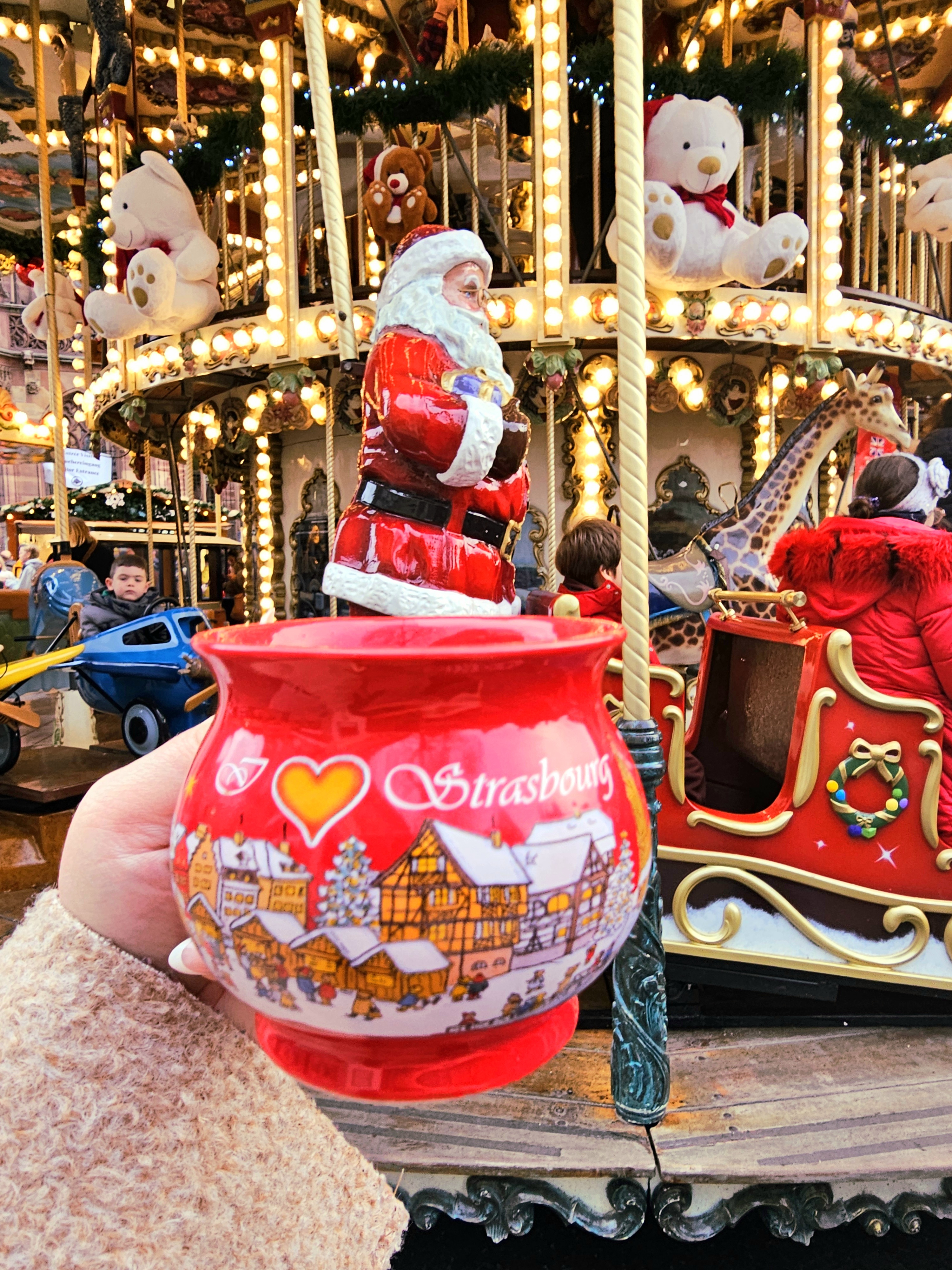
I ordered a white wine, which came in one of Colmar’s souvenir Christmas mugs. The drink and mug together cost me €11.50 (approximately $13). You could also buy a mug separately for €7 (around $8).
I love collecting little souvenirs from places I’ve visited, so the mug was definitely coming home with me. It felt like a much better reminder of the day than another fridge magnet.
If you’re visiting Colmar at Christmas, I’d make time to stop at the Carrousel Bar, even if you only want to see it. It’s one of those quirky attractions that adds to the town’s character.

Are the Six Colmar Christmas Markets Worth Exploring?
Unlike some European cities where one enormous Christmas market dominates the experience, Colmar has six smaller markets spread throughout its historic center.
For me, that was one of the biggest advantages. Each market has its own setting and character, and you can easily walk between them without needing buses or taxis.
Some focus more on traditional gifts and handmade decorations, while others are better for food, regional specialties, or families with young children.
The six main markets are:
- Place des Dominicains: Traditional Christmas stalls beside the beautiful Dominican Church, especially atmospheric when illuminated in the evening.
- Place de l’Ancienne Douane: A picturesque market around the Schwendi Fountain and the historic Koïfhus building, with festive decorations and gifts.
- Place Jeanne d’Arc: A cozy market centered around Alsatian food, regional produce, traditional treats, and local specialties.
- Koïfhus Indoor Craft Market: An indoor market featuring local artisans, handmade gifts, pottery, glasswork, and other crafts.
- Petite Venise: The children’s Christmas market, surrounded by beautiful half-timbered buildings and featuring family-friendly activities.
- Gourmet Market: A food-focused Christmas market in the Montagne Verte area, close to additional festive attractions, including the Ferris wheel.
I’d recommend exploring all six if you have enough time, rather than choosing just one. They’re all close together, and part of Colmar’s appeal is the walk between the different areas.
The historic buildings, canals, small squares, and decorated storefronts make the journey between markets just as enjoyable as browsing the stalls themselves.
Families will particularly enjoy the children’s market around Petite Venise and the attractions near Place Rapp. There were rides and plenty of festive displays when I visited, so it’s not somewhere that only appeals to adults interested in shopping and mulled wine.

For an overview of the different locations, you can find the official 2026 market map on the Colmar Christmas Markets website.
Is the Food at Colmar Christmas Markets Good?
The food was another highlight of my visit. Alsace has a wonderful mixture of French and German culinary influences, and you’ll find plenty of traditional regional specialties at the markets.
One of the first things I bought was a warm Bretzel, the large soft pretzel that’s popular throughout the region. It cost €4.50 (about $5), and after spending a couple of hours wandering around in the cold, it was exactly what I wanted.
The same stand was selling tarte flambée, also known as flammekueche. It’s a thin, crispy Alsatian flatbread traditionally topped with crème fraîche, onions, and bacon. If you’re visiting Alsace for the first time, I’d definitely recommend trying it.
You’ll also find sweet treats, gingerbread, Christmas cookies, hot drinks, and stalls specializing in local products. I liked that the food felt connected to the region rather than consisting entirely of the same generic Christmas market snacks.
My advice would be to allow time for several food stops throughout the day rather than rushing into a restaurant for every meal. Trying different snacks is part of the experience, and it also gives you a reason to explore more of the market areas.

Is Colmar Expensive at Christmas?
Colmar isn’t necessarily an expensive Christmas market destination once you’re there, particularly because the markets themselves are free to enter. You can spend hours exploring the streets, admiring the decorations, and browsing the stalls without paying an admission fee.
What can make a trip expensive is accommodation, especially during busy weekends in December. The town is extremely popular with visitors, and centrally located hotels can become costly as Christmas approaches.
Food and drink prices depend on what you buy, but I found that you could enjoy the atmosphere without spending a fortune.
Here are a few actual costs from my visit, with approximate US dollar conversions for comparison.
| What I Paid For | Price in Euros | Approx. USD |
|---|---|---|
| Entrance to Christmas markets | Free | Free |
| Warm Alsatian pretzel | €4.50 | $5 |
| Colmar souvenir mug | €7 | $8 |
| White wine with souvenir mug | €11.50 | $13 |
| Strasbourg to Colmar train ticket | €16.38 | $18 |
| Basel to Colmar train ticket | €18.27 | $21 |
These are prices I personally paid during my trip, not fixed prices for 2026. Train fares vary by route, ticket type, and travel date. US dollar amounts are approximate conversions using October 2026 exchange rates.
If you’re planning to visit from the United States, remember that France uses the euro, so you’ll pay in euros rather than dollars. It’s worth checking your bank’s foreign transaction fees before traveling.
For me, the Christmas markets offered good value because there was so much to see and enjoy without needing to book expensive activities.
The Biggest Downside: Colmar Gets Extremely Crowded
As much as I loved visiting Colmar, I wouldn’t want to give the impression that it’s a peaceful little Christmas village all day long.
The crowds were by far the biggest downside of my experience.
I visited on a Monday, and the town was already reasonably busy earlier in the afternoon. However, as the Christmas lights began to come on and more visitors arrived, the atmosphere changed quite dramatically.
By around 5:30 p.m., I found some of the streets almost unbearable. There were so many people trying to move through the narrow historic center that it became difficult to stop and look at the market stalls properly.
It was a shame because Colmar looked absolutely beautiful after dark. The illuminated buildings, decorated windows, and Christmas lights were some of the things I’d most been looking forward to seeing.
But rather than relaxing and enjoying the atmosphere, I found myself concentrating on getting through the crowds.
And this wasn’t even a weekend.
If you dislike busy places, or you’re traveling with young children, I’d definitely recommend planning your visit carefully. Arriving early makes such a difference, especially if you want to browse the stalls rather than just admire the decorations from a distance.

When Is the Best Time to Visit Colmar Christmas Markets?
Based on my experience, I’d recommend visiting Colmar on a weekday and arriving as close to the market opening time as possible.
In 2026, the main Christmas markets open at 11 a.m. Monday through Thursday and 10 a.m. Friday through Sunday. I would aim to be there shortly before opening, particularly if you’re arriving by train.
During the morning and early afternoon, you’ll have a better chance of exploring the stalls, taking photographs, and enjoying the atmosphere without quite so many people around.
However, I wouldn’t recommend leaving before sunset. One of Colmar’s biggest attractions at Christmas is seeing the buildings and streets illuminated, and it really does look magical.
During my visit, it was getting dark at around 4 p.m., so you don’t necessarily need to stay late into the evening to enjoy the Christmas lights.
My recommendation: Arrive when the markets open, spend the day exploring, and stay until shortly after the Christmas lights come on. That way, you get to experience Colmar in daylight and after dark without spending the entire evening in the heaviest crowds.
If you only have the option of visiting on a weekend, I’d still go, but I’d expect it to be busy and avoid trying to pack too many activities into the day.
Is One Day Enough for Colmar Christmas Markets?
Yes, I think one full day is enough to experience the Christmas markets in Colmar, particularly if you’re staying in Strasbourg or Basel and arriving by train.
The historic center is compact, and you can walk between all six main Christmas markets without needing public transportation. That makes it much easier to explore than some larger European Christmas market destinations.
I visited as a day trip and managed to enjoy the different market areas, try local food, stop at the Carrousel Bar, and see the decorations illuminated after dark.
That said, if I returned to Colmar, I’d be very tempted to stay overnight.
Having accommodation in the town would give you more flexibility. You could explore the markets early in the day, return to your hotel for a break, and head out again later to enjoy the Christmas lights.
It would also make it easier to explore the surrounding Alsace villages, many of which have beautiful Christmas markets of their own.
The only reason I’d hesitate is the price of accommodation. Hotels in Colmar can be expensive during the Christmas season, particularly on weekends, so I’d compare the cost of staying in Colmar with nearby Strasbourg or Basel before booking.
Colmar vs. Strasbourg Christmas Markets: Which Is Better?
I visited both Colmar and Strasbourg during my Christmas market trip, and although they’re close together, the two destinations feel quite different.
Strasbourg is a much larger city, with impressive Christmas decorations, beautiful architecture, and more of a big-city Christmas market atmosphere. There’s also plenty to see beyond the markets themselves.
Colmar, on the other hand, feels more like a small storybook town. Its colorful houses, canals, and tightly packed historic streets make it particularly picturesque, especially at Christmas.
Personally, I preferred Colmar. It was the destination I’d been most excited about visiting, and I loved how the entire town seemed to be decorated for Christmas.
But there are advantages to Strasbourg, particularly if you want a larger choice of hotels, restaurants, and other things to do during your visit.
My recommendation would be to visit both if you have the time. They’re only around 30–35 minutes apart by direct train, making it easy to combine them during the same trip.
If you are still deciding between the two, I have written a full Colmar vs Strasbourg Christmas Markets comparison, covering the atmosphere, decorations, food, and crowds from my own visits. You can also read about my experience of Strasbourg’s Christmas markets.
How to Get to Colmar Christmas Markets
Colmar is surprisingly easy to visit without a car, and I think traveling by train is one of the best ways to get there during the Christmas market season.
Its location in northeastern France means you can combine it with a wider trip around Alsace, Switzerland, or even Paris.
Getting to Colmar from Strasbourg
Strasbourg is one of the easiest cities to visit from. Direct regional trains usually take around 30–35 minutes, making Colmar a straightforward day trip or an easy addition to a longer Alsace itinerary.
I paid €16.38 (approximately $18) for my ticket when I traveled. This was the price for my journey, rather than a guaranteed fare for future visitors.
During the Christmas market season, regional trains can become extremely busy. I’d recommend purchasing your ticket in advance where possible and arriving at the station early enough to find your platform without rushing.
Getting to Colmar from Basel, Switzerland
Basel is another convenient starting point, especially if you’re planning to visit Christmas markets in more than one country.
The direct train from Basel SBB to Colmar takes approximately 45 minutes. During my visit, I paid €18.27 (around $21) for the journey, and I found it a straightforward way to travel between Switzerland and France.
Basel EuroAirport is also worth considering if you’re flying into the region. From the airport, you can travel onward through either the French or Swiss transport connections, depending on your itinerary.
Getting to Colmar from Paris
If you’re visiting France from the United States, Paris can be a convenient starting point for a trip to Alsace.
Direct high-speed TGV services from Paris Gare de l’Est can reach Colmar in approximately 2 hours and 20 minutes. Other trains require a change in Strasbourg, so check the exact route before booking.
Although a day trip from Paris is possible with suitable trains, I would personally recommend staying at least one night in Colmar or Strasbourg rather than spending most of the day traveling.
You can check current train schedules and fares through SNCF Connect, the official French rail booking platform.
For more details on the journeys, read my guide to getting to Colmar by train from Strasbourg, Basel and Paris. If you are flying into the region, my Strasbourg airport and train transport guide also covers connections from Paris, Basel EuroAirport and Strasbourg Airport.
Walking from Colmar Train Station to the Christmas Markets
Once you arrive at Colmar train station, the historic center and Christmas markets are within walking distance.
It took me roughly 10 minutes to reach the start of the festivities around Place Rapp. The walk was straightforward, and there were signs directing visitors toward the center.
You don’t need to rent a car or arrange a taxi just to explore the Christmas markets. In fact, during the festive season, much of the historic center becomes pedestrianized, making walking the easiest way to get around.
What Else Is There to See Near Colmar at Christmas?
One of my biggest regrets from my trip was not having enough time to explore some of the smaller Alsace villages surrounding Colmar.
Places such as Riquewihr, Eguisheim, and Kaysersberg are known for their traditional half-timbered buildings and charming Christmas markets. They’re exactly the sort of destinations I’d love to explore on a return visit.
I haven’t visited these villages myself yet, so I can’t compare their markets from personal experience, but they’re definitely high on my list for another trip to Alsace.
The region operates Christmas shuttle services to selected villages during the festive season, although routes and operating days vary. I’d recommend checking the latest information through the official Colmar Christmas website before planning your itinerary.
If I were planning a longer Christmas market trip, I’d allow at least two or three days in the region rather than trying to squeeze Colmar, Strasbourg, and the surrounding villages into a single day.
Colmar Christmas Market Dates and Opening Hours for 2026
The official dates for the Colmar Christmas markets in 2026 are November 23 through December 29.
The six main markets usually follow these opening hours:
| Day | Opening Hours |
|---|---|
| Monday–Thursday | 11 a.m.–7 p.m. |
| Friday–Sunday | 10 a.m.–8 p.m. |
| Christmas Eve, December 24 | 11 a.m.–5 p.m. |
| Christmas Day, December 25 | 10 a.m.–8 p.m. |
| December 26 | 10 a.m.–8 p.m. |
Some of the festive attractions continue beyond the main Christmas market dates. The Gourmet Market, Ferris wheel, and Christmas Fair at Place Rapp are scheduled to remain open through January 3, 2027, generally from 11 a.m. until 10 p.m., with an earlier closing time on New Year’s Eve.
These dates and hours are published by the official organizers, but it’s still worth checking for any last-minute changes before your visit.
For the most up-to-date details, visit the official Colmar Christmas Markets website.
Colmar Christmas Markets: Frequently Asked Questions
Are the Colmar Christmas markets free?
Yes. Entry to the six main Christmas markets is free, so you can wander between the stalls, enjoy the decorations, and explore the historic center without purchasing an admission ticket. You’ll only pay for food, drinks, shopping, rides, and any additional activities you choose.
Is Colmar worth visiting in December?
Absolutely. I think December is one of the most beautiful times to see Colmar. The Christmas decorations, festive lights, and traditional markets make its historic center especially atmospheric. Just be prepared for cold weather and potentially very large crowds.
How many days do you need in Colmar at Christmas?
One full day is enough to visit the six Christmas markets and enjoy the main attractions. However, I’d recommend staying overnight if your budget allows, particularly if you want to experience the town after dark or visit the nearby Alsace villages.
Is Colmar too crowded at Christmas?
It can be. During my visit, the historic streets became extremely crowded by around 5:30 p.m., despite it being a Monday. I’d recommend visiting on a weekday, arriving early, and exploring as much as possible before the late-afternoon crowds arrive.
My Verdict: Are Colmar Christmas Markets Worth Visiting?
Yes. Without hesitation, I’d recommend visiting the Colmar Christmas markets, especially if you love traditional European Christmas destinations.
Colmar was one of those places I’d been dreaming of visiting for years, and it genuinely lived up to the beautiful photographs I’d seen. The colorful half-timbered buildings, narrow streets, canals, elaborate decorations, and six Christmas markets make it an incredibly special place to experience during the festive season.
I loved the quirky Carrousel Bar, the traditional Alsatian food, the decorated restaurants, and how easy it was to explore everything on foot.
The one thing I’d do differently is plan my time around the crowds. I’d arrive early, enjoy the markets while they’re relatively quiet, and make sure I’d seen the Christmas lights before the streets became too busy.
And next time, I’d love to stay overnight and explore some of the surrounding Alsace villages that I missed on this trip.
If you’re planning a Christmas market vacation in France and can only choose one smaller destination in Alsace, I think Colmar deserves to be very high on your list.
Explore More of Alsace
Planning to visit Strasbourg and Colmar? These four related guides share more of my firsthand experiences and practical advice for traveling around Alsace.
How to Get to Colmar from Strasbourg, Basel & Paris
Are Strasbourg Christmas Markets Worth Visiting?
How to Get to Strasbourg from Paris, Basel & Strasbourg Airports