Looking for the best things to do in Tropea, Italy? This beautiful little town on the Calabrian coast is somewhere I completely fell in love with during my solo trip around southern Italy.
With colorful buildings perched dramatically above the sea, beautiful beaches, little cobbled streets and some of the most incredible coastal views I’ve seen in Italy, Tropea is absolutely worth adding to your itinerary.
I visited in May, spending one night in Tropea after two nights in nearby Scilla. I traveled entirely by public transportation, arriving by train and exploring everything in town on foot.
And my biggest regret? Only staying for one night! I’ve explained why, and what I’d do differently, in my honest review of Tropea.
I’d originally thought an afternoon and evening would be plenty of time to explore, but Tropea turned out to be bigger and livelier than I’d expected. There were so many beautiful streets, beaches and viewpoints that I could easily have spent another day here.
One of the things I loved most was that you don’t need to book expensive activities to enjoy Tropea. Some of my favorite moments were simply wandering through the historic center, admiring the views and enjoying a glass of wine beside the beach.
In this guide, I’ll share 12 of the best things to do in Tropea, including the places I personally explored, attractions worth adding to your itinerary and a few excursions I’d consider if I returned for longer.
I’ll also explain how long you need, whether you can visit without a car and how to make the most of a short stay.

Affiliate disclosure: This guide contains some affiliate links. If you make a booking through them, I may earn a small commission at no additional cost to you. I’ve clearly distinguished my own experiences from activities I researched but didn’t personally do.
Best Things to Do in Tropea at a Glance
Tropea is a relatively compact town, so you can see many of its highlights on foot without needing a packed sightseeing itinerary.
These are the 12 experiences I’d recommend considering:
- Explore Tropea’s historic center.
- Find the incredible clifftop viewpoints.
- Admire Santa Maria dell’Isola Sanctuary.
- Spend time at Spiaggia della Rotonda.
- Explore the beaches around Marina dell’Isola.
- Enjoy a drink at a beachfront bar.
- Experience Tropea’s historic center in the evening.
- Try traditional Calabrian food and Tropea’s famous red onions.
- Visit Tropea Cathedral and discover the town’s history.
- Watch the sunset over the Tyrrhenian Sea.
- Take a boat trip along the Coast of the Gods.
- Explore more of Calabria with a day trip.
You certainly don’t need to do all 12. I’d prioritize the historic center, viewpoints, beaches and Santa Maria dell’Isola if you’re only visiting for one day. I’ve put these highlights into a practical route in my Tropea in one day itinerary.
1. Explore Tropea’s Historic Center
If there’s one thing I would absolutely recommend doing in Tropea, it’s spending some time wandering around the historic center.
This was one of my favorite parts of the visit, and it doesn’t cost anything.
Tropea’s old town sits on top of a dramatic cliff overlooking the Tyrrhenian Sea. Its narrow streets are filled with traditional Italian buildings, little shops, restaurants, balconies and hidden corners that open onto incredible coastal views.
I found myself constantly stopping to take photographs.
Sometimes it was a beautiful old building or a little square, and sometimes I’d turn a corner and suddenly find the sea right in front of me.
The historic center is compact enough to explore without following a strict route, and I actually think that’s the nicest way to experience it.
Start around Corso Vittorio Emanuele, the main street through the historic center, and then explore the smaller streets leading away from it.
You’ll find plenty of restaurants, souvenir shops, local food stores and little squares where you can stop for something to eat or drink.
Look out for:
- Corso Vittorio Emanuele: The main street, filled with shops, restaurants and beautiful old buildings.
- Largo Ercole: One of the attractive squares in the historic center.
- Via Boiano and Largo Galluppi: Areas where you can admire some of Tropea’s historic palaces and architecture.
- The smaller side streets: Some of the prettiest corners are the ones you’ll discover by wandering away from the main route.
I visited in May, when the temperature was around 77°F, and found it perfect for exploring. It was warm enough to feel like a proper summer vacation without being unbearably hot. I’ve shared the weather, beach season and crowd levels in my best time to visit Tropea guide.
I’d allow at least an hour or two to wander around the historic center, particularly if you enjoy photography as much as I do.
My tip: Don’t rush through the old town just to reach the beach. Tropea is one of those places where the town itself is a huge part of the experience.
2. Find Tropea’s Incredible Clifftop Viewpoints
One of the main reasons I’d wanted to visit Tropea was the scenery, and the viewpoints certainly didn’t disappoint.
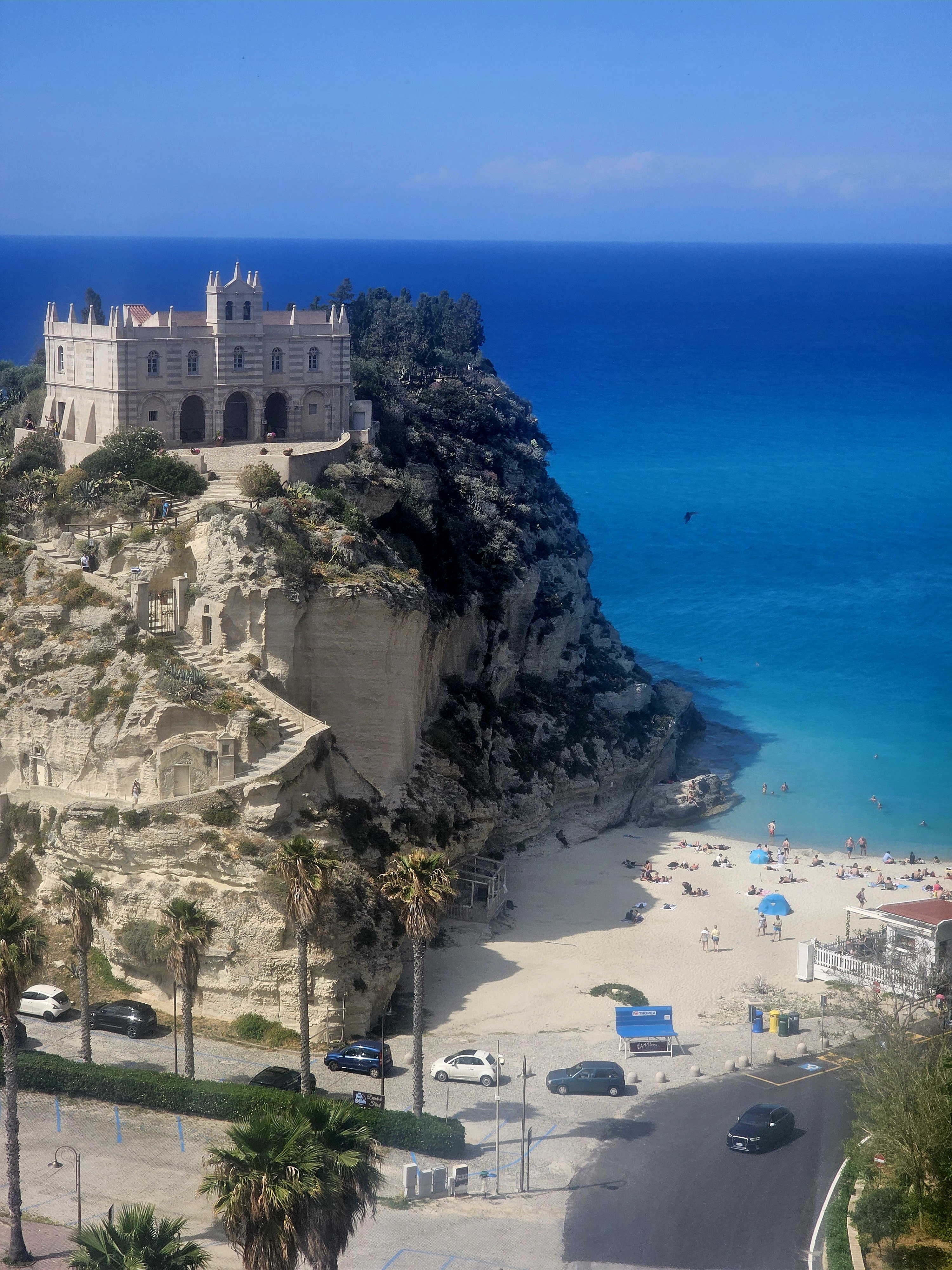
The old town is perched high above the sea, with buildings sitting right on the edge of the cliffs and beautiful sandy beaches stretching out below.
From above, the water is the most incredible shade of blue.
Honestly, some of the views looked more like somewhere in the Caribbean than mainland Italy.
My favorite thing was simply walking through the town and discovering the different places where you could look out over the coastline.
There are several viewpoints worth finding, including:
- Largo Migliarese: One of Tropea’s most famous panoramic viewpoints, looking out towards the sea and coastline.
- The end of Corso Vittorio Emanuele: A lovely place to enjoy the view after exploring the main street.
- Piazza Cannone: Another viewpoint worth seeking out for views of the coastline and Santa Maria dell’Isola.
You don’t need to pay for these public viewpoints, and they’re a brilliant way to enjoy Tropea even if you’re not planning to spend time on the beach.
I’d particularly recommend taking a little time to enjoy the views rather than just stopping for a quick photograph.
It’s easy to understand why Tropea is considered one of the most beautiful coastal towns in Calabria.
3. Admire Santa Maria dell’Isola Sanctuary
You really can’t visit Tropea without noticing Santa Maria dell’Isola.
It’s the town’s most recognizable landmark and probably the image you’ve seen if you’ve been researching Tropea on Instagram or Pinterest.
The historic sanctuary sits on top of a huge rocky outcrop beside the sea, surrounded by beautiful beaches and turquoise water.
From the clifftop viewpoints in town, it looks absolutely spectacular.
I spent time admiring the scenery around the sanctuary, but I didn’t go inside during my short visit.
However, if you’ve got a little longer than I did, it’s definitely worth considering.
Can You Visit Santa Maria dell’Isola?
Yes. Visitors can climb the staircase carved into the rock to reach the sanctuary.
The site includes the historic church, gardens and panoramic viewpoints overlooking Tropea and the surrounding coastline.
It’s worth knowing that the climb involves a substantial number of steps, so it may not be suitable for anyone with limited mobility.
Opening hours and visitor access can change depending on the season, and some areas may have an admission charge.
I’d recommend checking the official Santa Maria dell’Isola website before visiting.
Even if you don’t go inside, I’d still make time to admire the sanctuary from the town and the beach below. It’s one of the most beautiful sights in Tropea.
4. Spend Time at Spiaggia della Rotonda
Tropea has some absolutely gorgeous beaches, and Spiaggia della Rotonda is one of the most famous.
It’s located beneath the dramatic cliffs of the historic center, with beautiful clear water and the old buildings rising high above the sand.
This part of Tropea was one of the highlights of my visit.
After spending time exploring the old town, I made my way down towards the beaches and spent a few hours enjoying the scenery.
I’m not really someone who wants to spend an entire day sunbathing. I much prefer walking around, taking photographs and stopping somewhere for a drink.
But even I could appreciate just how beautiful the beach was.
The combination of the clear blue sea, sandy beach and towering cliffs makes Tropea feel quite different from many other Italian beach destinations.

How Do You Get Down to Tropea Beach?
There are pedestrian routes and staircases connecting the historic center with the beaches below.
Walking down is relatively straightforward, but remember that you’ll need to climb back up afterwards.
Tropea’s cliffs are quite high, and the steps can feel much harder when it’s hot.
I’d recommend wearing comfortable shoes for exploring the town and saving your beach sandals for when you actually reach the sand. If you’re choosing accommodation, my where to stay in Tropea guide explains which areas are most convenient for the historic center and beaches.
There are public beach areas where you can bring your own towel, along with beach clubs that rent umbrellas and loungers during the main season.
If you visit in July or August, expect the beaches to be much busier than they were during my May trip.
5. Explore Marina dell’Isola and the Beaches Around the Sanctuary
Another beautiful beach area is Marina dell’Isola, close to Santa Maria dell’Isola Sanctuary.
This is one of the most recognizable stretches of coastline in Tropea, with the dramatic sanctuary rock providing a beautiful backdrop.
Depending on the exact beach area, you’ll find places to swim, relax on the sand or simply enjoy the coastal scenery.
The water is particularly appealing on a sunny day, and during the warmer months it’s a popular place for swimming.
The coastline around Tropea also has small coves, rocky areas and sea caves, although some are only accessible from the water.
One of the better-known natural features is Grotta del Palombaro, a sea cave near the sanctuary rock.
I didn’t explore the cave myself, but it’s something to look into if you’re planning a boat excursion or enjoying a longer stay in Tropea.

6. Enjoy a Glass of Wine at a Beachfront Bar
This might not sound like a major tourist attraction, but it was honestly one of my favorite parts of visiting Tropea.
After exploring the town and spending time down by the sea, I stopped at a beachfront bar for a glass of white wine.
And with the beautiful beach, cliffs and sunshine all around me, it was a pretty lovely place to spend part of the afternoon.
Sometimes it’s the simplest things that make a trip memorable.
I’d been traveling around Calabria on my own, and by the time I reached Tropea I’d really settled into enjoying my own company.
I could explore at my own pace, stop whenever I fancied and sit enjoying the view without worrying about anyone else’s plans.

You’ll find bars and seasonal beach establishments along the coastline, particularly during the warmer months.
Whether you want a cold drink, a light lunch or somewhere to relax for an hour, I’d definitely recommend making time for a stop beside the sea.
It’s also a lovely option if you’re visiting Tropea on a short sightseeing trip rather than planning a full beach day.
7. Experience Tropea’s Historic Center in the Evening
One thing I really enjoyed about staying overnight was seeing how Tropea changed as the sun went down.
During the day, the historic center was beautiful for exploring and taking photographs, but in the evening it had a completely different atmosphere.
Restaurants started filling up, people were sitting outside with drinks, and the little streets and squares felt really lively.
I’d spent the previous two nights in Scilla, which had been much quieter, especially around the traditional fishing village of Chianalea.
Tropea definitely felt busier, with more restaurants, shops and people around in the evening.
I liked both towns, but they offered quite different experiences.
That evening, I found somewhere to have dinner and enjoyed being able to sit outside, have some wine and people-watch.
Before this trip, I’d been a little apprehensive about eating out alone. By the time I arrived in Tropea, I was completely comfortable doing it.
In fact, I found it really enjoyable.

If you’re deciding whether to visit Tropea as a day trip or stay overnight, this is one of the reasons I’d recommend spending at least one night here.
It’s lovely during the day, but I think you’d miss part of the experience if you left before dinner. Even if you only have a short stay, my one-day walking itinerary will help you plan the sights before enjoying the evening atmosphere.
8. Try Traditional Calabrian Food and Tropea’s Famous Red Onions
Something you’ll notice when exploring Tropea is how proud the town is of its local food.
In particular, Tropea is famous for its red onions, known as Cipolla Rossa di Tropea.
These sweet red onions are one of Calabria’s best-known regional products, and you’ll see them featured in shops, restaurants and local dishes throughout the town.
They’re even protected by a geographical designation, which recognizes the traditional growing area and the product’s distinct characteristics.
If you’re interested in trying local Calabrian food, look out for:
- Tropea red onions: Often used in salads, pasta dishes, pizza and other regional recipes.
- Fileja pasta: A traditional Calabrian pasta frequently served with tomato sauce, meat sauces or local specialties.
- ‘Nduja: A spicy, spreadable Calabrian pork sausage used in pasta sauces, on bread and on pizza.
- Local seafood: Tropea’s coastal location means you’ll find plenty of fish and seafood dishes.
- Gelato: Always a welcome option when you’re exploring an Italian town in warm weather!
I’m not a big seafood person, so I’d be much more interested in the pasta and pizza options than a traditional seafood restaurant.
But whether you’re adventurous with food or prefer something familiar, there are plenty of restaurants and cafes around the historic center.
I’d recommend having at least one meal in town rather than treating Tropea purely as somewhere to visit for the beach.
9. Visit Tropea Cathedral and Discover the Town’s History
Tropea isn’t just a beach destination. It also has a long and interesting history, with several historic churches and buildings hidden among the streets of the old town.
One of the most important is the Cathedral of Maria Santissima di Romania, also known as Tropea Cathedral.
The cathedral dates back to the Norman period in the 12th century, although it has been altered and restored over time.
It’s an important religious site for the town and contains historic religious artworks, including an image of the Madonna of Romania, Tropea’s patron saint.
According to local tradition, the Madonna is associated with the protection of the town.
I didn’t spend time exploring the cathedral interior during my visit, but it would definitely be worth including if you have an interest in history, architecture or churches.
There are also several other historic religious buildings and traditional palaces around the old town, so keep an eye out for these as you explore.
I’d recommend checking visiting hours locally, as religious buildings may close during services or at certain times of day.
10. Watch the Sunset Over the Tyrrhenian Sea
Tropea’s west-facing coastline makes it a lovely place to enjoy the evening light over the sea.
If you’re lucky with the weather, you may even be able to see the Aeolian Islands on the horizon.
The famous volcanic island of Stromboli lies offshore, and on clear days it can be visible from parts of the Calabrian coast.
Some of the best places to consider for sunset include the clifftop viewpoints, the beaches and the waterfront bars.
I loved the atmosphere of Tropea in the evening, and this is something I’d make even more time for if I returned.
My recommendation would be to explore the old town first, find somewhere with a lovely sea view and enjoy a drink before heading out for dinner.
It’s a much more relaxed way to end the day than trying to squeeze in another attraction.
11. Take a Boat Trip Along the Coast of the Gods
One thing I’d definitely consider doing if I returned to Tropea for a longer stay is taking a boat trip along the coastline.
Tropea is located on a beautiful stretch of Calabria known as the Costa degli Dei, or Coast of the Gods.
The coastline is famous for its clear water, dramatic cliffs, hidden coves and beautiful beaches.
Some of the smaller bays and caves are much easier to explore from the water than from land.
Boat excursions departing from Tropea commonly include sections of coastline around:
- Santa Maria dell’Isola, viewed from the sea.
- Grotta Azzurra, the Blue Cave.
- Riaci Bay and its rocky coastline.
- Capo Vaticano and the surrounding coves.
- Snorkeling stops when weather and sea conditions allow.
Some trips also include an aperitif or snorkeling equipment, depending on the operator and the excursion.
I didn’t take a boat trip during my one-night stay, so I can’t personally review any particular tour.
However, the coastline looked incredible from land, and I think seeing it from the water would be a lovely way to spend a few hours.
You can explore an example of a coastal excursion on the official Calabria tourism website.
Just remember that boat trips are seasonal, and departures depend on weather and sea conditions. I’d check availability for your travel dates before making plans.
12. Explore More of Calabria on a Day Trip
If you’re staying in Tropea for several nights, there are some beautiful places nearby that are well worth exploring.
I only had one night in Tropea, so I didn’t manage to fit in any excursions from the town itself.
However, there are a few destinations I’d consider depending on how much time you have and whether you’re traveling by car or public transportation.
Capo Vaticano
Capo Vaticano is one of the best-known coastal areas near Tropea, famous for its beautiful beaches, clear water and dramatic coastal scenery.
It’s particularly appealing if you enjoy swimming, snorkeling or exploring different beaches.
Some of the most famous beaches are in the Grotticelle area, although reaching particular coves may involve steep paths or local transportation.
If you’re traveling without a car, I’d check local train connections and the onward journey from the station before planning your visit.
A boat excursion from Tropea can be another way to experience part of the Capo Vaticano coastline.
Scilla
I’d also highly recommend combining Tropea with Scilla, because that’s exactly what I did during my Calabria trip.
Scilla is a beautiful little fishing town further south along the coast, with traditional waterfront houses, a historic castle and gorgeous views over the Strait of Messina.
It has a very different atmosphere from Tropea.
Where Tropea feels like a lively seaside destination with lots of restaurants and beaches, Scilla feels smaller and more traditional, particularly around Chianalea.
I spent two nights in Scilla before traveling to Tropea by regional train, and the journey took me around one hour and fifteen minutes.
If I was planning the same trip again, I’d probably reverse the order and spend two nights in Tropea and one night in Scilla.
I’ve written a separate guide to the best things to do in Scilla, including my favorite viewpoints, beaches and experiences. If you’re deciding which town to prioritize, my Scilla vs Tropea comparison covers the differences after staying in both.
The Aeolian Islands
For something a little different, you could also look into a boat excursion to the Aeolian Islands.
This volcanic island group lies off the coast of Sicily and includes islands such as Lipari, Vulcano and Stromboli.
During the main tourist season, excursions are available from Tropea and surrounding ports, with routes and island stops depending on the operator.
Some trips involve several hours at sea and may take up a full day or longer, so this is something I’d plan separately rather than trying to squeeze it into a short visit.
I haven’t taken an Aeolian Islands excursion from Tropea myself, but it’s an interesting option if you’re staying in Calabria for a longer vacation.
Check the itinerary carefully, as some tours focus on island visits while others include an evening cruise to view Stromboli from the sea.
How Many Days Do You Need in Tropea?
Based on my experience, I’d recommend spending at least one night in Tropea, but preferably two.
I arrived by train from Scilla, spent the afternoon exploring the town and beaches, stayed overnight and then traveled back towards Reggio Calabria the following morning.
It was enough time to see some of the main sights, but I definitely felt like I’d left too soon.
Here’s how I’d plan your time:
| Time in Tropea | What I’d Recommend |
|---|---|
| Half a day | Explore the historic center, admire the viewpoints and visit the beaches. |
| One full day | Add Santa Maria dell’Isola, a relaxed lunch and more time by the sea. |
| One night | See the main sights and enjoy the restaurants and evening atmosphere. |
| Two nights | Explore without rushing, spend more time on the beaches and consider a coastal boat tour. |
| Three or more nights | Enjoy Tropea at a slower pace and include excursions to Capo Vaticano or other nearby destinations. |
For me, two nights would be ideal if you’re visiting Tropea as part of a wider southern Italy itinerary. For a shorter stay, see my Tropea one-day itinerary to choose which stops to prioritize.
You could still spend plenty of time exploring, but without feeling like you need to constantly check the time.
Can You Visit Tropea Without a Car?
Absolutely, and this is one of the things I particularly liked about Tropea.
I traveled around Calabria entirely by public transportation and found Tropea relatively easy to reach and explore.
The town has its own train station, which is approximately a 10–15 minute walk from the historic center.
When I arrived from Scilla, I simply walked from the station to my accommodation, dropped off my backpack and headed out to explore.
Once you’re in the historic center, most of the main attractions are within walking distance.
You don’t need a car to visit the viewpoints, wander around the old town or get down to the main beaches.
The main thing I’d be aware of is the terrain.
There are hills, uneven streets and quite a few steps, particularly when walking between the historic center and the beaches.
And if you’re planning to explore further along the coast, public transportation may be less convenient than staying within Tropea itself.
For train routes, airport connections and practical advice, read my guide to how to get to Tropea without a car.
Where Should You Stay in Tropea?
If you’re visiting for one or two nights, I’d strongly recommend staying in or close to the historic center.
That’s where I stayed, and the location was brilliant.
I booked a room at Terrazzo del Borgo, a little guesthouse right in the center of town.
I chose it because the room had a private terrace overlooking the sea, and I’m easily persuaded by a beautiful balcony!
It turned out to be one of my favorite accommodation choices of the trip.
I could walk straight out into the historic center, reach the beach within minutes and enjoy the restaurants and shops without worrying about transportation.
My room cost £61.56 for the night when I booked, which worked out at roughly $80 at the time, and breakfast at a nearby cafe was included.
Obviously, hotel prices change depending on the season and availability, but I thought it was fantastic value for the location.

I’ve written a full guide to where to stay in Tropea, including my accommodation and other options for different budgets and travel styles.
When Is the Best Time to Visit Tropea?
I visited in May, and personally, I thought the timing was perfect.
Temperatures during my trip were around 77°F, which was warm enough for spending time by the sea but still comfortable for walking around the historic center.
The town was lively without feeling overwhelmingly busy, and I found accommodation prices quite reasonable.
If you’re visiting mainly for sightseeing, I’d consider May, June, September or early October.
July and August are generally hotter and busier, particularly because they coincide with the main European summer vacation period.
However, if you’re hoping to swim every day and spend most of your vacation on the beach, the warmer summer months may suit you better.
September could be a particularly good compromise, with warm weather and sea temperatures that have benefited from the summer sunshine.
You can read my full guide to the best time to visit Tropea, including monthly weather, crowds, prices and my personal experience visiting in May. If you’re splitting your trip between the two towns, I’ve also compared the seasons in my best time to visit Scilla guide.
Is Tropea Worth Visiting?
Yes, absolutely!
I’ve visited quite a few beautiful destinations around Italy, and Tropea is somewhere I’d happily return to.
What makes it special isn’t necessarily a huge number of major tourist attractions.
It’s the combination of the old town, dramatic clifftop views, beautiful beaches and relaxed southern Italian atmosphere.
You can spend the morning exploring historic streets, the afternoon beside the sea and the evening enjoying dinner in a beautiful little square.
And you don’t need a particularly large budget to enjoy the experience.
My favorite parts of Tropea were either completely free or involved spending very little money.
I also think it’s a lovely destination for a solo trip. I felt comfortable exploring on my own, found it easy to get around without a car and really enjoyed the atmosphere.
Of course, no destination is perfect for everyone.
If you prefer lots of museums, major attractions and a packed city-break itinerary, Tropea might feel a little quiet.
But if you enjoy beautiful scenery, wandering through historic streets, discovering lovely places to eat and spending time by the sea, I think you’ll love it. My Is Tropea Worth Visiting? guide goes into the things I loved and the reasons I wish I’d booked longer.
Frequently Asked Questions About Things to Do in Tropea
What is Tropea most famous for?
Tropea is best known for its dramatic clifftop historic center, beautiful beaches, clear turquoise water and Santa Maria dell’Isola Sanctuary. It’s also famous for its sweet red onions, which are a traditional product of the surrounding area.
Are there free things to do in Tropea?
Yes! Exploring the historic center, visiting the public viewpoints and spending time on the public sections of the beaches are all free. You can enjoy plenty of Tropea’s highlights without booking paid attractions.
Can you see Tropea in one day?
Yes, you can see many of Tropea’s highlights in one day. I’d prioritize the historic center, viewpoints, Santa Maria dell’Isola and the beaches. However, I’d recommend staying overnight if you can because the town has a lovely evening atmosphere.
Is Tropea walkable?
Tropea’s historic center is relatively compact and easy to explore on foot. However, there are hills and steep staircases connecting the upper town to the beaches, so comfortable shoes are a good idea. Some attractions may not be suitable for visitors with limited mobility.
Is Tropea good for a solo trip?
I think so. I visited Tropea on my first proper solo trip abroad and really enjoyed it. The town was easy to explore on foot, I felt comfortable eating out alone and the train connections made it possible to visit without renting a car.
Is Tropea better than Scilla?
I loved both, but they’re quite different. Tropea is larger and livelier, with more beaches, restaurants and streets to explore. Scilla is smaller and feels more like a traditional fishing village, especially around Chianalea. I think they’re both worth visiting if you have time. See my Scilla vs Tropea comparison for a fuller breakdown.
Can you take a boat trip from Tropea?
Yes. Seasonal boat excursions operate along the Coast of the Gods, including routes towards Capo Vaticano and nearby coves. There are also excursions to the Aeolian Islands at certain times of year. Availability depends on the season and weather conditions.
Would I Visit Tropea Again?
Without hesitation.
In fact, if there’s one thing I’d change about my Calabria trip, it would be spending more time here.
I loved Scilla, but Tropea had so much more going on than I’d expected, and I really felt like another day would have been worthwhile.
I’d love to return in May or September, stay for two or three nights, spend more time exploring the beaches and maybe finally take one of the coastal boat trips.
But even if you only have one day, I think Tropea is absolutely worth visiting.
Sometimes the best travel experiences aren’t about ticking off lots of attractions. They’re about finding somewhere beautiful, slowing down and just enjoying being there.
And for me, that’s exactly what Tropea was.
More Tropea and Calabria Travel Guides
If you’re planning Tropea or a longer trip around Calabria, these guides will help with the practical details, from accommodation and trains to deciding how long to stay in each town.
- Tropea in One Day – A walking itinerary covering the historic center, beaches and viewpoints.
- Where to Stay in Tropea – My sea-view guesthouse and five other accommodation choices.
- How to Get to Tropea Without a Car – Train connections, airports and my journey from Scilla.
- Best Time to Visit Tropea – Month-by-month weather, sea temperatures and seasonal crowds.
- Is Tropea Worth Visiting? – What I loved and why I wish I’d stayed another night.
- Scilla vs Tropea: Which Is Better? – My firsthand comparison of the two coastal towns.
- Best Things to Do in Scilla – Chianalea, Ruffo Castle, Marina Grande and nearby trips.
- One Day in Scilla – A relaxed walking itinerary for the fishing village.
- Where to Stay in Scilla – The different areas and my apartment overlooking the castle.
- How to Get to Scilla Without a Car – Airports, trains and ferry connections.
- Best Time to Visit Scilla – Weather, swimming and my experience in May.
- Is Scilla Worth Visiting? – My honest review after two nights in Scilla.